Divorce Financial Planning:
Frequently Asked Questions
Divorce raises financial questions that most attorneys aren’t equipped to answer — and that generic search results rarely get right. The answers below are written by Lisette Smith, CDFA®, CFP® and Tanya Rapacz, CFP®, financial advisors who specialize exclusively in helping high-achieving women navigate complex divorces.
Use this page to understand your options, get clear on what matters, and know the right questions to ask your advisors. If something here applies to your situation and you’d like to talk through it, we offer a complimentary, no-judgment conversation. Schedule one here.
A Certified Divorce Financial Analyst® (CDFA®) is a financial professional who specializes in the intersection of financial planning and divorce. While an attorney handles the legal process, a CDFA® focuses exclusively on the financial decisions and the long-term consequences of those decisions.
A CDFA® helps you understand the true after-tax value of each asset in your settlement, model different settlement scenarios so you can see real-world outcomes before agreeing to anything, evaluate the tax implications of dividing retirement accounts, real estate, and investments, and ensure that equity compensation like RSUs and stock options isn’t overlooked or undervalued.
For women with straightforward finances and few assets, a CDFA® may not be essential. But for high-achieving women with complex compensation packages, business interests, significant retirement assets, or real estate, the cost of not working with one can be greater than the cost of hiring one. Financial decisions made during divorce have ripple effects for decades, and a CDFA® gives you the analysis to make those decisions with confidence.
At Divorce Advisory, both Lisette Smith, CDFA®, CFP® and Tanya Rapacz, CFP®, TPCP® bring over 20 years of experience helping women protect their wealth through complex divorces. Learn more about why a CDFA® matters for women with significant assets, or schedule a complimentary conversation to discuss your situation.
A Financial Affidavit is a sworn legal document you submit to the court as part of the divorce process. It provides a comprehensive picture of your financial situation including what you own, what you owe, what you earn, and what you spend. Courts use this document as a foundation for determining property division and spousal and child support.
Because it is sworn testimony, accuracy matters enormously. Errors or omissions, even unintentional ones, can have serious consequences in your settlement.
A complete Financial Affidavit typically needs to include assets (bank accounts, investment and brokerage accounts, retirement plans, real estate, business interests, equity compensation, life insurance cash values, and vehicles), liabilities (mortgage and HELOC balances, credit cards, loans, business debts, and tax liabilities), income from all sources (salary, bonuses, equity, rental income, business income, and any support received), and current monthly expenses by category including housing, childcare, healthcare, transportation, and debt payments.
For high-earning women, the assets section requires particular attention. Equity compensation, deferred compensation, and business ownership interests are frequently undervalued or overlooked. Getting professional appraisals and valuations early before negotiations begin is essential.
Our free Divorce Financial Clarity Checklist walks you through exactly what to gather for your Financial Affidavit.
The financial impact of divorce on women is significant and often underestimated. Research shows that women over 50 experience a 45% drop in their standard of living following divorce, compared to 21% for men (Lin & Brown, 2020). Even women who are the primary earner are not immune. Being the higher-earning spouse often means being the Payor in a settlement, which introduces its own long-term financial pressures.
Several factors drive this gap. Women tend to live longer than men, which means retirement assets need to stretch further. If a woman stepped back from her career at any point during the marriage for children, a move, or other family reasons, her earning trajectory and Social Security benefits may have been affected. And the financial decisions made in the heat of a divorce (keeping the house, accepting a lump sum, overlooking tax implications) can have consequences that don’t become visible until years later.
The good news is that with the right financial planning, many of these risks are avoidable. Understanding your full financial picture before negotiations begin, building a realistic post-divorce budget, and planning proactively for retirement are among the most important steps you can take. Read our guide to the most common financial mistakes women make in divorce and how to avoid them.
Getting your financial documents organized before divorce proceedings begin is one of the highest-impact things you can do. It gives you an accurate picture of your net worth, forms the basis of your Financial Affidavit, and prevents you from being caught off-guard during settlement negotiations.
At a minimum, you’ll want documentation across five categories: assets (what you own), liabilities (what you owe), income (what you earn), expenses (what you spend), and risk and estate documents such as life insurance policies, wills, and beneficiary designations.
For high-achieving women, a few areas deserve extra attention. Equity compensation statements for RSUs, ISOs, NQSOs, and ESPP are frequently overlooked but can represent significant value. Business ownership records and valuations need to be addressed early, since valuation is a process that takes time. And retirement account statements matter not just for their current value, but for understanding what a fair division looks like after taxes.
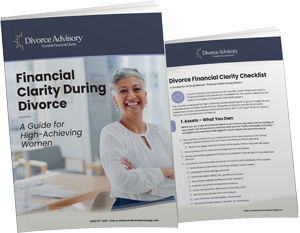
We created a free, detailed Divorce Financial Clarity Checklist specifically to help with this step. It walks you through the documents to gather across all five categories. Download it along with our companion guidebook, Financial Clarity During Divorce.
Equity compensation is one of the most valuable and most commonly mishandled asset categories in high-earning divorces. RSUs (Restricted Stock Units), ISOs (Incentive Stock Options), NQSOs (Non-Qualified Stock Options), and ESPP (Employee Stock Purchase Plan) shares all require careful analysis and different treatment depending on when they were granted, when they vest, and what state you live in.
The core question courts examine is what portion of the equity was earned during the marriage. For RSUs granted before the marriage but vesting after, or granted during the marriage but vesting post-separation, the calculation involves allocating value between marital and separate property. This is not straightforward, and the method used can significantly change what each spouse receives.
Tax treatment adds another layer of complexity. Different types of equity are taxed differently when exercised or sold, and those implications need to factor into how equity is valued and divided not just what appears on a statement.
For women in tech, finance, or executive roles, equity can represent a substantial portion of total compensation and net worth. Leaving it unexamined or accepting an oversimplified split is one of the most costly mistakes we see. Our deep-dive post on equity compensation in divorce covers this topic in detail. A CDFA® can work with your financial records to properly value unvested and vested equity and ensure it is treated fairly in your settlement.
Understanding this distinction is foundational to any divorce financial settlement. In general, marital property refers to assets and debts acquired by either spouse during the marriage, regardless of whose name is on the account. Separate property refers to assets one spouse owned before the marriage, or received during the marriage as a gift or inheritance to them individually.
What makes this complicated in practice is that the lines frequently blur. A home purchased before the marriage but paid for with marital income may have both separate and marital components. An inheritance deposited into a joint account may lose its separate property protection through a concept called “commingling.” A business started before the marriage but grown significantly during it may have a marital component that needs to be calculated and divided.
State law also matters significantly. Community property states (such as California) generally divide marital assets 50/50. Equitable distribution states (like Massachusetts and Maryland) divide assets based on fairness, which doesn’t always mean equal.
For high-achieving women, the separate vs. marital property analysis is often where significant money is won or lost. Properly tracing the origins of assets with documentation requires financial expertise alongside legal expertise. A CDFA® can help ensure what is rightfully your separate property stays that way, and that marital assets are accurately identified and fairly valued before negotiations begin. See how a CDFA® approaches these complex asset questions.
The financial decisions made during divorce can have ripple effects for decades. Several costly mistakes come up again and again, especially for women with significant assets.
Keeping the family home without fully understanding the long-term cost is one of the most common. The emotional pull is understandable, but carrying a mortgage, property taxes, maintenance, and insurance solo, often after refinancing at a higher rate, can strain your finances for years. A CDFA® can model whether keeping the home is financially sustainable or whether other options serve you better.
Overlooking the tax implications of asset division is another. A $500,000 IRA and $500,000 in a brokerage account are not the same; the former carries a future tax bill on every withdrawal. Accepting a “50/50 split” without understanding the after-tax value of each asset can leave you with significantly less than you expect.
Other common pitfalls include leaving equity compensation unexamined, failing to update estate documents after the divorce is final, underestimating post-divorce living expenses particularly healthcare and not thinking ahead to what retirement looks like now that you’re planning solo.
We’ve written a comprehensive post covering the six most costly mistakes in detail. It’s one of the most important things you can read before your negotiations begin
Retirement accounts are often a couple’s most significant assets after the family home, and divorce puts them squarely on the table. How they’re divided and what happens to your retirement plan going forward deserves careful, dedicated attention.
In community property states like California, retirement savings accumulated during the marriage are typically split evenly. In equitable distribution states such as Massachusetts, the division is based on factors like earning ability and future needs. Either way, what looks like a fair split on paper may not be once taxes and long-term growth potential are factored in.
Dividing retirement accounts also requires getting the mechanics right. Employer-sponsored plans like 401(k)s require a Qualified Domestic Relations Order (QDRO) to split without triggering taxes or penalties. IRAs are handled differently, as part of the standard divorce settlement.
Beyond the immediate division, there are longer-term questions to address: Do you need to adjust your retirement age? How does living on one income affect how much you need to save? If you were married for 10 or more years, you may be eligible to claim Social Security based on your ex-spouse’s record even if they remarry which can meaningfully change your retirement income picture.
Women live longer than men on average, making retirement planning after divorce both more important and more complex. Our guide to divorce and retirement for women over 40 walks through exactly how to approach this, with practical steps for getting back on track.
Taxes can quietly reshape the true value of your divorce settlement, sometimes dramatically. A million dollars on paper may turn into considerably less once the tax implications are factored in, and for women with complex compensation, real estate, or business interests, tax awareness is essential.
Several areas are particularly important to understand. First, the date your divorce is finalized determines your filing status for the entire year; whether that’s before or after December 31 can meaningfully change what you owe. Second, not all assets are tax-equivalent: a traditional IRA and a Roth IRA with the same balance have very different after-tax values, and accepting highly appreciated stock without accounting for embedded capital gains can result in a significant surprise later.
Alimony treatment changed significantly in 2019: for divorces finalized after January 1, 2019, alimony is no longer federally deductible for the payer or taxable to the recipient, though state tax treatment varies. Child support is not taxable or deductible.
For women with equity compensation, the tax complexities multiply. RSUs trigger ordinary income when they vest, options have different treatment depending on type, and deferred compensation carries its own rules. Higher earners may also face exposure to the Net Investment Income Tax or the Alternative Minimum Tax depending on how their settlement is structured.
A financial advisor who incorporates tax planning can help ensure you’re seeing the full after-tax picture before you agree to anything. Our post on divorce and taxes covers each of these issues in depth and is essential reading before finalizing any settlement.
When you’re the primary earner in a divorce, the financial picture flips in ways that catch many women off guard. Rather than focusing on what you might receive, you’re often focused on what you may owe. Planning accordingly is critical.
As the higher-earning spouse, you may be designated as the Payor in the settlement, meaning you could be responsible for spousal support, child support, or both. The amount and duration of support payments depend on factors including the length of the marriage, your income relative to your spouse’s, the standard of living during the marriage, and your state’s laws.
Support obligations directly affect your post-divorce cash flow and your ability to save for retirement, maintain your lifestyle, and cover the new costs of living solo. Modeling these scenarios before negotiations begin is essential.
There are also asset division complexities that specifically apply to high earners: business interests, executive compensation, deferred income, and significant retirement savings all require careful valuation and strategy. And as the higher earner, you may face a more complex tax picture post-divorce, including changes to your withholding, estimated payments, and investment income exposure.
None of this means you’re at a disadvantage. But, it means you need a team that understands your specific situation. Our guide to the financial considerations for the breadwinner wife covers the key issues to address, and working with a CDFA® ensures your financial plan accounts for both your obligations and your long-term goals.
The short answer: hire a divorce financial advisor as early in the process as possible, ideally before negotiations begin.
Your attorney’s role is to navigate the legal process, advocate for your rights, and negotiate the terms of your settlement. While this is essential work, attorneys are not typically trained to model the long-term financial outcomes of different settlement options, calculate the after-tax value of asset tradeoffs, or build a post-divorce financial plan. That’s where a divorce financial advisor (particularly a CDFA®) comes in.
Think of it this way: your attorney builds the legal case. Your CDFA® builds the financial case that supports it. When they work in coordination, you go into negotiations with a much clearer picture of what different outcomes actually mean for your life.
The earlier you engage a financial advisor, the more useful they can be. They can help you identify what documents to gather, understand the full scope of your marital assets, spot assets that might otherwise be overlooked (equity compensation, deferred compensation, pension values), and model scenarios so you know what you’re agreeing to before you sign. Bringing in a CDFA® after the fact — when a settlement is nearly finalized — limits their ability to protect you.
At Divorce Advisory, we work alongside your attorney, not instead of them. See what working with us looks like from start to finish, or schedule a complimentary conversation to ask your specific questions.
Divorce is one of the most important times to revisit your estate plan and one of the most commonly overlooked. Many people assume their divorce decree automatically updates their beneficiary designations and other estate documents. In most cases, it does not.
Beneficiary designations on retirement accounts, life insurance policies, and investment accounts are governed by the documents you filed with the plan administrator not your will. If your ex-spouse is still listed as a beneficiary on your 401(k) or life insurance policy after your divorce is finalized, they may still receive those assets if something happens to you.
Some states (including California) automatically revoke certain designations upon divorce such as your ex’s role as executor or power of attorney. This is not universal, and it does not extend to all account types. The safest approach is to proactively update everything.
Key documents to review and update after divorce include your will, durable power of attorney, healthcare proxy and advance directive, life insurance beneficiaries, retirement account beneficiaries, trust documents, and guardianship designations if you have minor children.
Note that if you’re required to pay spousal or child support, life insurance policies may need to list your ex-spouse as beneficiary for the duration of the support obligation. This is sometimes mandated in the divorce decree itself.
Our post on the top financial mistakes women make in divorce covers estate planning in detail, including what to update and when. A CDFA® and your estate attorney should both be part of this process.
A Qualified Domestic Relations Order (QDRO) is a legal document separate from your divorce decree that instructs an employer-sponsored retirement plan how to divide the account between you and your former spouse. It is required any time a 401(k), 403(b), pension, or similar employer plan is being divided in a divorce.
Without a properly filed QDRO, the plan administrator cannot legally transfer a portion of the account to your ex-spouse or to you, if you’re receiving a share. Attempting to divide a retirement plan without one or using the wrong method can trigger taxes and early withdrawal penalties that neither party intended.
A QDRO must be approved by both the divorce court and the plan administrator before it takes effect. The process takes time and must be handled carefully: the QDRO needs to specify the exact amount or percentage being transferred, the form of payment, and when distributions can begin. Errors in drafting can delay the transfer or create unintended tax consequences.
One important distinction: IRAs do not require a QDRO. IRA transfers between spouses in divorce are handled differently, through a process called a “transfer incident to divorce,” and must be executed correctly to avoid triggering taxes.
For women with significant retirement assets, the QDRO process is worth understanding early. A CDFA® can help ensure the division is structured correctly, coordinated with your attorney, and aligned with your broader retirement plan. Our retirement and divorce guide covers QDROs alongside the other key retirement considerations for women over 40.
Building a realistic post-divorce budget is one of the most practical and important things you can do both for your own clarity and for settlement negotiations. Your financial life is changing in fundamental ways, and a thoughtful budget helps you understand what you actually need going forward.
Start by separating your current expenses into two categories: what will stay the same and what will change. Housing costs often shift significantly whether you’re keeping the home and refinancing solo or starting fresh somewhere new. Health insurance is another major variable, particularly if you were covered under a spouse’s plan. Healthcare costs, including premiums and out-of-pocket expenses, need to be fully accounted for on your own.
Also account for expenses that are easy to underestimate: childcare, transportation, home maintenance, professional fees (legal and financial), and the one-time costs of establishing a new household. If you’re paying or receiving spousal or child support, those amounts directly affect your available cash flow.
On the income side, be realistic about what your earnings look like post-divorce, including any changes to bonus structure, equity vesting, or work schedule. If you’re receiving support, model what your budget looks like both with and without it as support arrangements can and do change.
A transition budget is especially useful during the first one to two years, when expenses tend to be higher and your new financial normal hasn’t fully settled. Your CDFA® can help build this alongside your broader post-divorce financial plan, ensuring your settlement negotiations are grounded in what you actually need not just what seems fair on paper. Download our free Divorce Financial Clarity Checklist for a structured starting point for documenting your current income and expenses.